
How to say this?
Julie--GrannyJ--died Monday evening in the hospital.
I have been meaning to post an update for everyone about her hospital stay; she wanted me to let y'all know that she had a "shiny new toy"--aka pacemaker--and was healing up and ready to start blogging again. But, alas, I kept putting it off.
She entered the hospital two weeks ago for shortness of breath, which was diagnosed as bronchitis. While she was there, her cardiologist and her care doctor decided she needed the pacemaker, stat. While they were implanting the pacemaker, she suffered a collapsed lung. Things seemed to be getting better; she was healing, she had good color, she was just waiting to get out and was looking forward to having me take her on a few drives.
But then she suffered an additional post-surgery complication, something called an "ileus", which means your digestive tract has shut down. Normally, an ileus resolves itself, but hers persisted, and the docs were trying everything they could.
Nothing worked.
Her body--tired of all the medical procedures--simply gave out, she had a breathing crisis, and then her heartbeat plummeted (even with her fancy "shiny new toy"). I was there, holding her hand, while she passed. Far better this way than spending a few more years declining more and more.
She loved this blog, and all her interactions with every one of her commenters. I know you all will miss her--but not as much as I will, and the rest of her family and IRL friends.
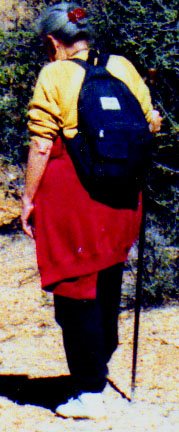
The picture at the top is of her and my father, when they were newly a couple. The picture below is from just two years ago, showing her with her trusty walking stick and one of her favorite R.E.D. sweatshirts with a splendid northwest coastal Indian graphic. She loved exploring Arizona, and even as her health deteriorated, she did her best to keep exploring.
If you feel like doing something in her name, I was thinking that you should try to locate a local wildflower organization and donate to it in her name. Mom loved wildflowers, and she did her best to cultivate them in her gardens over the years. Sometimes it succeeded, sometimes it didn't. One of her joys was venturing out into the woods, whether the various forest preserves around the Chicago area, or the national forests here in Arizona, and discovering which flowers were out and about.
I will probably be posting various memories for a while at my own blog; you are welcome to come read and share.
Peace and blessings to you all--OmegaMom/Kate



 Posts
Posts


