Showing posts with label milkweed. Show all posts

Sunday, August 13, 2006

Munch. Munch. Munch. Munch. Munch. Munch.


We had a good rain this afternoon, the first in about five days. Sadly, good rain always brings out more herbivores, such as this snail. These pesky creatures are also the first plant munchers of the season, in great numbers.


They adore hollyhock leaves -- among other tasty goodies from the garden. As a result, I've had to start my hollyhocks indoors in pots; young plants in the ground are decimated by snails and their peers, the slugs.
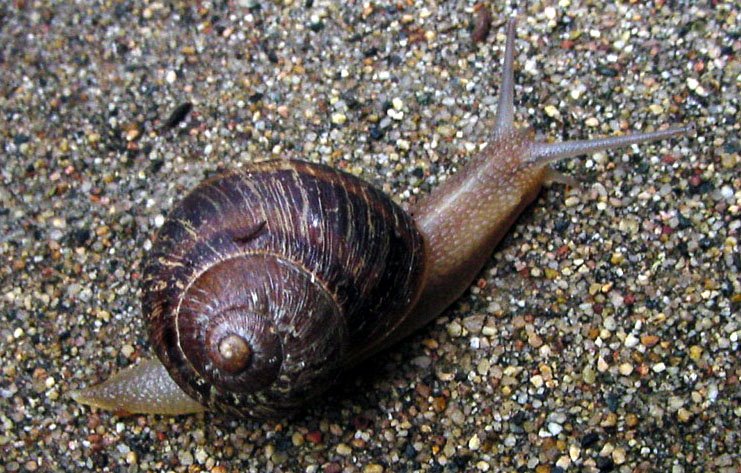

Here's a better picture of one of today's snails. (I've finally discovered how to do close-in shots with my little Sony.)
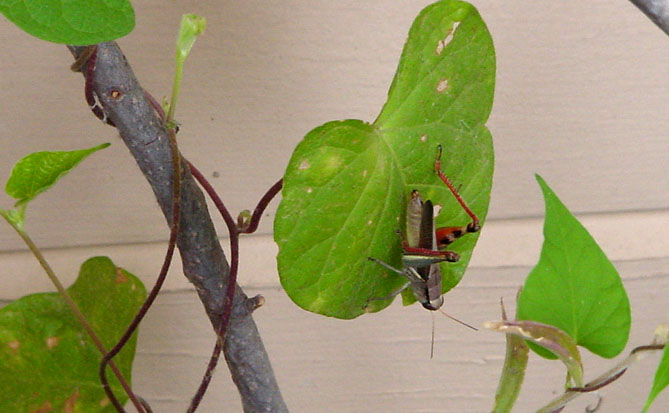

The critter above is the guilty party for the munched out hollyhock leaf, to be perfectly honest. (I had that particular plant in a container on the porch, safe from snails.) The several kinds of grasshopper emerge later in the season than the snails; this fellow has neatly striped legs, if you look carefully. By the way, I don't spray any of the critters because I have a dear cat (DC) that wanders the yard.
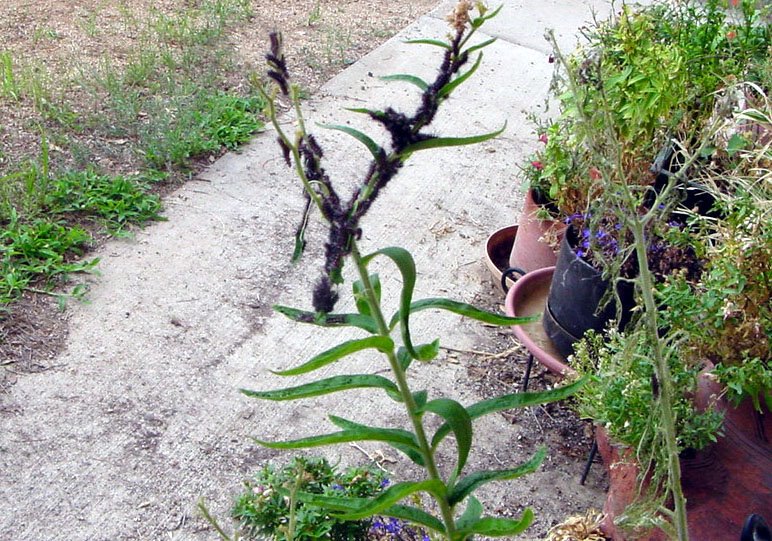

Besides, I got caught up in the behavior of a batch of woolly bears that discovered my Martha Stewart milkweed (the Peruvian variety.) A batch of these fuzzy caterpillars appeared of a sudden and began munching out on this single plant.
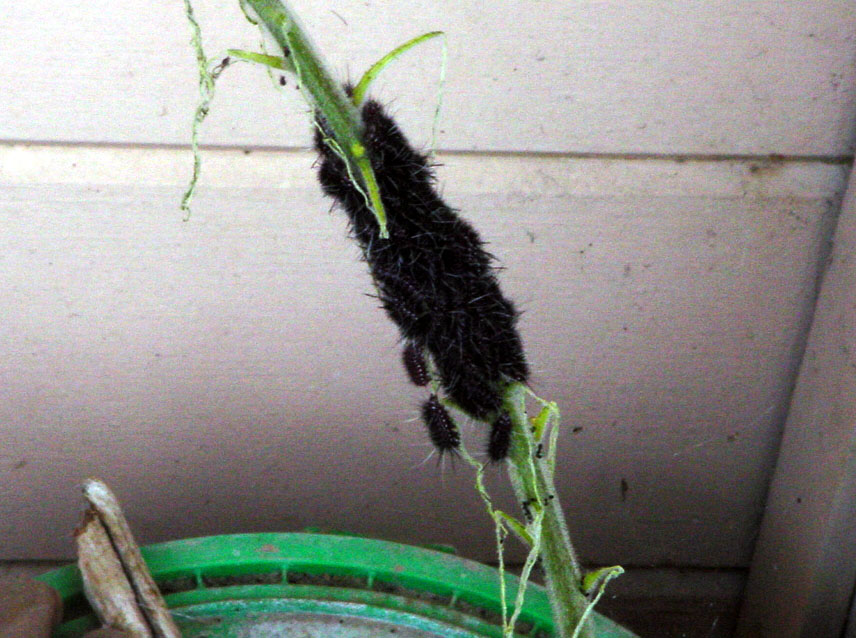

One morning was overcast and cooler; the critters were huddled together, to keep warm, possibly.
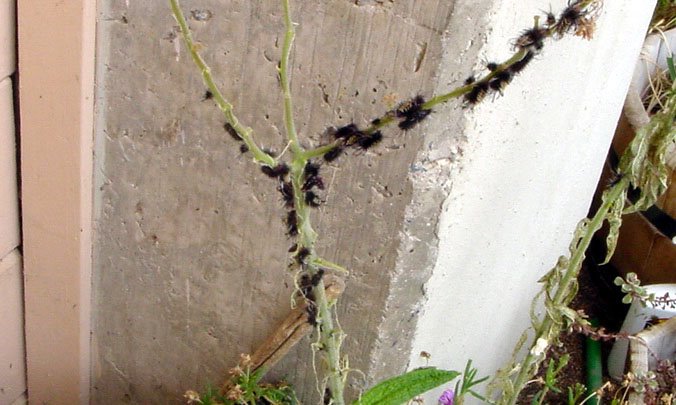

Here they have nearly denuded the milkweed stem.
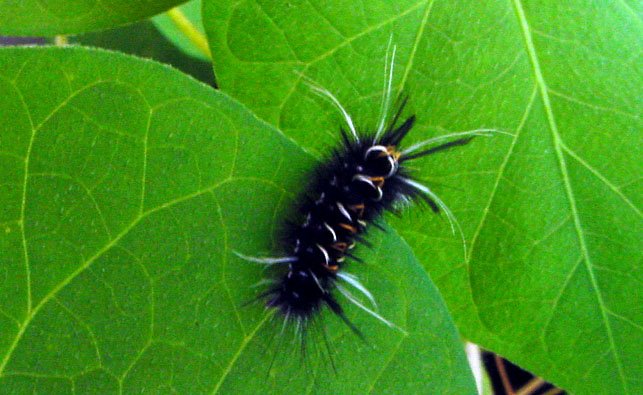

Yesterday they abandoned the now leafless milkweed and spread out, hunting for more food.


And guess what -- though I hadn't realized it, there was another, smaller milkweed a good six to eight feet away in another large pot. But those woolly bears found it and started gathering again this afternoon.

Of course, it was time to consult The Google, to see what I could learn about woolly bears with such finicky eating habits. Took some drilling down, but I found out that they are tiger moth larvae -- in particular, a variety of (surprise) milkweed moth.

With 21 species of tiger moth reported in Yavapai County, we have just one kind of milkweed moth (Euchaetes antica). The picture of the Oklahoma variety sure bears a family resemblence to my crop.

Don't ask me what I'm going to do next. Maybe get rid of the woolly guys and save my #2 milkweed...maybe keep watching them to see what they do next. I have to decide tomorrow.

Next Day: At 9 a.m. I went downstairs to pick up the papers. #2 milkweed stripped bare -- and woolly bears nowhere to be seen. I suppose they have scattered, looking for yet another milkweed. And I have only one -- located a good 30 feet away, in the ground, as opposed to my garden of pots. When I took a quick glance, some had already found it.

Also I noted on the skeleton of the original plant that the little black dots I had seen earlier were now more the size of rain drops and developing the same sorts of bristles as my earlier crop!

Thursday, June 15, 2006

Garden Wildflowers

In case you haven't already guessed, I'm an enthusiast for growing native wild flowers in local gardens. It can be a problem obtaining them, however. At this time of year, Watters carries some natives, primarily the shrubbier specimens, but also some penstemons and other flowering plants.

For the best selection of high country wild flowers, however, drive up I-17 to Flagstaff Native Plant and Seed. Most of the plants they carry will survive at our lower elevation (5200 ft. vs. Flag's 7000.)


A good native for the Prescott landscape is bear grass, which really should take the place of pampas grass all over town. It's in bloom right now among the granites out Iron Springs Road (on the right hand side as you head out of town), along western- most Gurley, and up Coronado. This plant was photographed by a friend; it is a feature of his garden.

The seed heads are even showier than the flowers. Besides, if our world comes to an end, you could always grind the seeds into a flour and weave baskets or shoes from the leaves, Indian-style.

And don't worry about bear grass taking over. It will, but the process takes some 50 or so year for this slow growing plant.


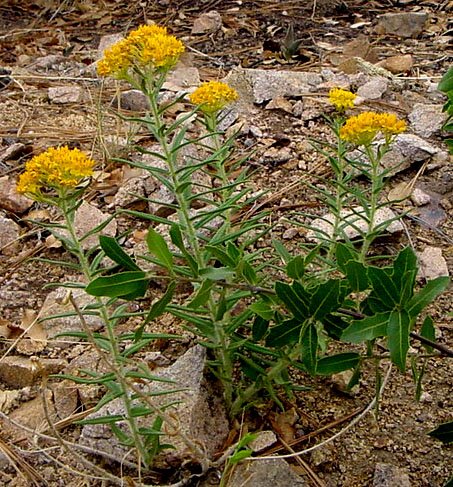
The commercial nursery folk have finally discovered just how spectacular native milkweed plants can be. The butterfly weed above is growing out of the rocks near Gurley Place. I have one, too, which is happy on my hillside.

This is the first of the asclepias to be gentrified (note that you'll never see the term "milkweed" in a garden catalog -- unless it is a highly specialized offering for butterfly fanciers!) The butterfly weeds in these parts are a rich buttery yellow. In the Midwest, they are more of a red orange.

Back in the Midwest many years ago, I tamed not only the Chicago- namesake wild onion, but also a common milkweed, which has huge leaves and a very pretty ball of dusty pink flowerettes. That was the year I got a ticket from an officious city minion for having broken the weed ordinance!

In these parts, you'll find butterfly weed out at Granite Basin Lake, uphill from the concrete picnic tables ... along Iron Springs Road (I saw one today) ... and, if you're up to a trip, the very very best displays of all are along the West Fork trail in Oak Creek Canyon.

Among other milkweeds in these parts are antelope horns and an interesting vining milkweed, which I first saw along the Agua Fria River at Badger Springs.


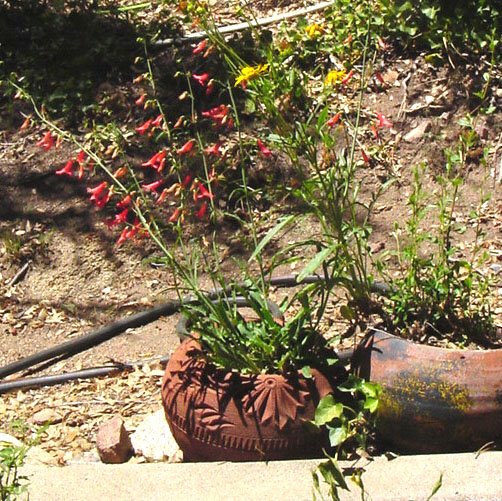
You wouldn't think that anything as completely adapted to to the high desert as penstemon barbatus would be so happy potted and watered, but this plant of mine has prospered. It is one of two red penstemons found in the Prescott area -- and one of eight penstemon varieties I've located growing wild between the Bradshaws and the Upper Verde River. But more about these wonderful humming bird flowers later, when I have the necessary time and references.!
 
Photo Blog Blog Top Sites Blog Directory for Prescott, AZ

Local Blogs - Blog Top Sites