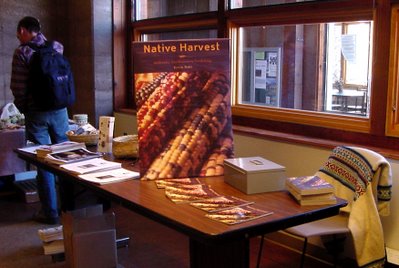
Today's occasion was a book signing and lecture -- not the usual way I spend an afternoon. However, it was over at Prescott College's Crossroads Center, a not-too-strenuous walk from my house. The author in question is Kevin Dahl, executive director of Native Seeds Search in Tucson. Good reasons for the PC venue: Dahl is an alumnus and the subject is one near and dear to hearts at the college. Namely, rescuing Southwestern and Mexican native food plants from oblivion and possibly making a dent in the high incidence of diabetes in the process. Can't say that my sometimes cynical heart disagrees with that objective.
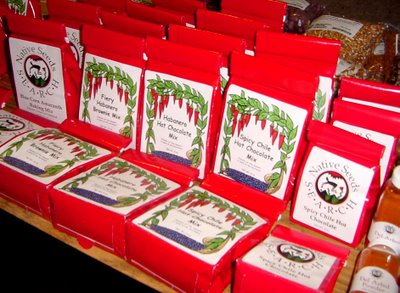
Before the serious business, there were the product displays to check out. The packaging was bright, cheerful and enticing. Native Seeds Search has fostered lines of mixes for everything from pancakes made with amaranth or blue corn flour to spicy hot chocolate, all using products of its seed farm. To name a few. Unfortunately, I hadn't worn my backpack to carry stuff home -- I'll have to make any purchases from their
web site.
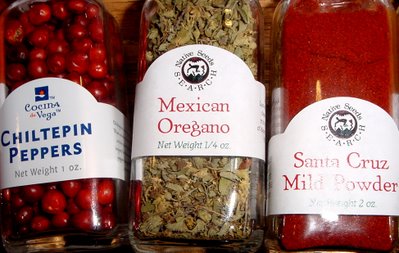
The chiltepin peppers above are basically the wild progenitor of all chilis.
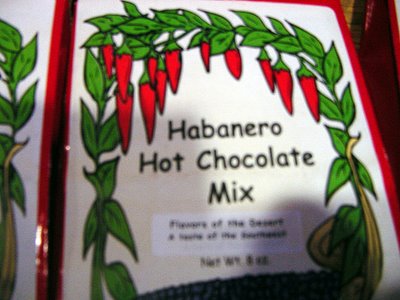
While that habenero hot chocolate mix is a perfect gift for one of my friends who is in the big leagues when it comes to hot sauce macho.
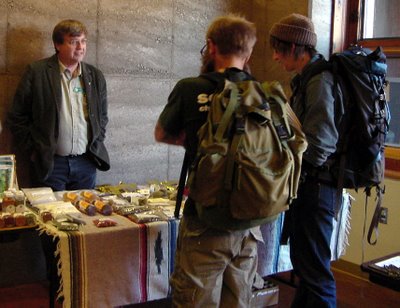
Before the lecture, Dahl answers questions from students.

Then is faced with the latest in modern technology at the podium. His lecture covered the "three sisters" -- corn, beans and squash in their hundreds of varieties -- plus other native food/fiber plants, including amaranth, cotton, devil's claw and several cacti.
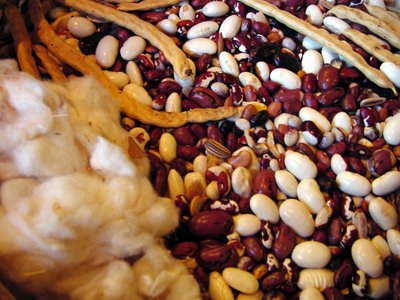
And he had a storehouse of fascinating facts for the trivia fan, like me. For instance, while the devil's claw pod is edible when young, tender and green, it is the source of the toughest of fibers when it is mature. Another: humans are the only mammal to eat capsaicin bearing chilis; apparently, birds do not have capsaicin receptors and so devour the little red berry-like chilis and spread the seeds. Yet another: watermelons were introduced to Mexico by the Conquistidores; they proved so popular that seeds spread via trade routes throughout America and watermelons were already cultivated in the Midwest by the time the English and French explorers arrived.
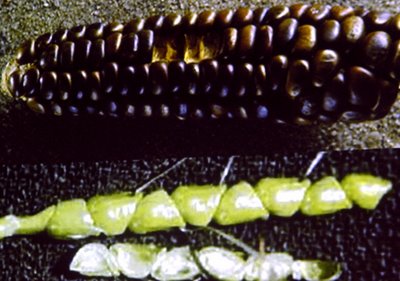
Of course, corn was
the staple for Native Americans. Above, one of the oldest lines of corn, next to teosinte, the wild grass from which corn was derived. Today, noted Dahl, corn is totally domesticated -- none, including the native varieties, survives without man to cultivate it. Fascinating side notes about corn: there was, long ago, a period of over a thousand years when corn was grown by natives, not for food, but for the beer made from sugar-rich stalks! And there's good reason Hopi corn is planted on those sandy fields: about a foot down, there's a layer of clay that holds the necessary moisture.
Fascinating stuff. Too bad I'm too old and set in my ways to start farming traditional corn, beans and squash. I'll stick to a couple of pots of tomatoes (another of those wonderful native crop derivatives) and my very native wildflowers.
 ...and GrannyJ was fortunate enough to capture an image of that seed and its parachute. Isn't that a beaut? I've no idea which fluff ball produced the seed, but look at all the fascinating detail. And to think that at one point I couldn't get a decent macro shot with my little Canon. (Then one day I took the trouble to read the instructions.)




 Posts
Posts


