
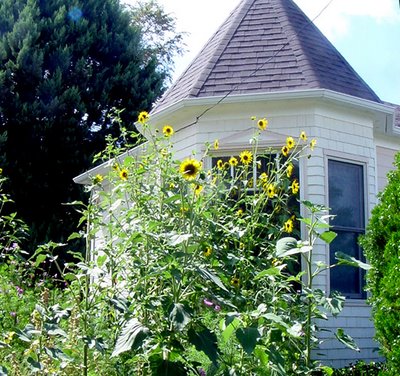
One of the signs of the season is this little sales stand on McCormick at the foot of Willis. The owner of the rehabbed Victorian not only grows old fashioned
single hollyhocks, but also a jungle of 8 to 10 foot tall
sunflowers. Should you happen by, don't miss the fence of sunflowers along McCormick.

Standing right behind that for-sale stand is the third of the McCormick Street junk-yard horses. He's in the shade, which is why I didn't include him in my
earlier post about Gene Galazan and his horses. Do take note that this horse has a feed bucket, tho I was disappointed that it was furnished with straw instead of more appropriate iron filings.
But, getting back to the subject, Iowa State University
horticulture news offers this interesting history of the helianthus:
Native Americans in the U.S. have been using wild sunflower for food and medicine for at least 8,000 years. Archeological evidence suggests that Native Americans began cultivating and improving the sunflower as early as 2300 B.C. Thus, sunflower cultivation may predate cultivation of the "Three Sisters" of corn, beans and squash.
The seeds of sunflower were usually roasted and ground into a fine meal for baking or used to thicken soups and stews. "Seed-balls", similar to peanut butter, made from sunflower butter made a convenient carry-along food for traveling. Roasted sunflower hulls were steeped in boiling water to make a coffee-like beverage. Dye was extracted from hulls and petals. Face paint was made from dried petals and pollen. Oil, extracted from the ground seeds by boiling, provided many tribes with cooking oil and hair treatment. Medicinal uses included everything from wart removal to snake bite treatment to sunstroke treatment.
When the colonists and explorers sent seed from the New World back to Europe, the sunflower was treated mainly as a curiosity and a garden flower. It was not used as an edible crop again until it reached Russia. In Russia, the Holy Orthodox Church forbade the use of many foods, including many rich in oil, during Lent and Advent. The Russians eagerly accepted the sunflower as an oil source that could be eaten without breaking the laws of the church. Russians also enjoyed sunflowers as a snack food. In the past 50 years, Russians have bred sunflowers for high oil content and improved disease resistance. In 1966, an open pollinated Russian bred cultivar was introduced into the U.S. This and other cultivars began the first sustained U.S. commercial production of the oil seed type of sunflower.
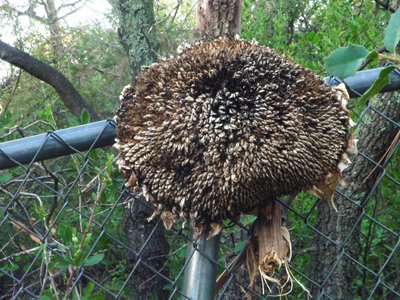
For the past couple of years, I have bought giant seed heads of the Russian variety at Young's Farm. The blue jays love the seeds -- tho only the top half of this head (below) has been eaten. The remaining seeds are apparently too vertical for a jay to reach.
A delightful idea I came across several years ago is to plant a "jungle" of giant sunflowers for toddlers to wander. A variation on this idea: sunflower "houses."
For everything sunflower, you can visit
Sunflower Lovers; they even offer posters (though not the Van Gogh!)
 My husband never quite understood why I was so fond of Maximilian Daisies; he was only too aware of their aggressive nature, a tendency to take over the garden if and when the circumstances are right. I guess that it's just the nature of the human male to be wary of any other aggressor!
 Be that as it may, I've had a clump of these perennial sunflowers almost as long as I've lived in the current house. Always figured they were named after the Emperor Maximilian and hence were natives of Mexico and New Mexico. Just to make sure, I consulted the USDA plant guide and was disabused, only to find out that Maximilian sunflower is native to the central United States [and Canada], from Ontario, Michigan, and Ohio, west to Alberta, Montana, Wyoming, and Colorado and south to Texas. It may be sparsely introduced east and west of its native range.
 The unique habit of this sunflower is that the many blossoms range up and down the single stalk, instead of branching out. Note how the buds (above) and the developing flower head (below) grow.


 Unlike the more common garden sunflower and the highly bred crop sunflower, the Maximilian is a perennial -- which accounts for its spreading habit. Because the perennial roots dig far deeper into the soil and thus offer much greater erosion resistance, USDA plant breeders are working to create new crop varieties to compete with those annual giants raised for their oil and food seeds, according to an recent article in Scientific American.
 More info about the daisy: Native Americans used parts of this plant as sources of food, oil, dye, and thread. Pioneers planted Maximilian sunflowers near their homes to repel mosquitoes and used the blossoms in bathwater to relieve arthritis pain, the USDA says.
 And now for a confession: I currently grow three stalks of the daisy in a large pot. Those glorious flowers at the introduction to this post (and below) are over on Grove Street, where there's plenty of room and, I suspect, the soil is a lot friendlier than my decayed granite.



 Posts


