 Oh that I should be so lucky as to see, much less photograph the critters that friend Bob espies over in Mountain Club. In this particular batch, a lone coyote (above) and grey squirrel plus a raven. I'm sure the raven was up to no good.
 Oh that I should be so lucky as to see, much less photograph the critters that friend Bob espies over in Mountain Club. In this particular batch, a lone coyote (above) and grey squirrel plus a raven. I'm sure the raven was up to no good.
 At least for the Ladies'. Wildlife. Certainly appropriate for the Lynx Lake Store/Cafe location in the forest. Though I was happy to see one of my favorite critters celebrated, I couldn't help noticing that stiff, outsized tail. The little chipmunk is one of our smaller ground squirrels; you'll find them everywhere, even in the wood pile on my back porch.
 Much better executed -- the mountain lion (cougar/catamount/puma). Not a guy you care to meet up with. Definitely not in the woodpile on my back porch, though lions periodically put in an appearance within the city limits.
 Foxes? Yes, they certainly make a home in our mountains and forests, but they are very seldom seen outside our little local zoo.
 On the other hand, several years have passed since the bald eagle pair began nesting right across the lake from the cafe. If you have binoculars, you can see their home each spring as you sip coffee. With more luck, you'll also see them fish the lake.
 No need to call on M. Champagne when you've got an ecologist Sson who's in pig heaven when he's out phographing nature in the raw. I tagged along and let him point out the critters well before my ancient eyebones had adapted to each new scene as the car moved slowly on the levee beside the bayou. Whenever he found a good spot, we'd stop.
 Turtles. Big ones. Bigger than the turtles I found in my bathtub, yet.
 Very important, those logs. For the turtles and for the G*A*T*O*R. whose vertical strips don't quite match the horizontal stripes of his perch.
 I was lucky enough to photograph two more of the reptilians, both floating in the water like logs, patiently waiting for food to come a little closer. Gave me a chance to picture how beautiful bayou water can be. Especially in late spring, before the mosquitoes have matured enough to swarm one. Not a bite did I get.
 Here's another inhabitant of bayou country, living on the dry land that is found near the levees between huge pools of water. The bunny was sufficiently camouflaged that it took me forever to find him in my viewfinder. I'm sure that one of those alligators would have had no big problem seeing him, however. As for the birds, I actually have enough pictures for a separate post. Real Soon Now.
 Max has been aware for sometime that Something That Smells Like Prey lives among the sawed up oak trees. I only became aware of the critter recently when I heard a gnawing sound while eating my breakfast out in my cool back porch/grotto. I now put out bits of fruit everyday; every night, they are gone. But note the carrot pieces in the above picture -- they've been there for a couple of days. The little guy turned up his nose, obviously.
 Now to continue where I left off last night ... about my other big problem. Bird photography. Bought the new Canon Powershot for its 12x zoom lens, hoping to improve my odds at home despite 1) the lack of bird bath and feeder and 2) the overly wooded hillside. The birds are there, but I seldom can catch an entire bird -- even if one sits still long enough! I was lucky with the (I presume) house finch above. But the picture doesn't tell you much about the bird.
 Yes, the humidity has moved up a lot -- from 4% midday into the 20s. But the rains have not arrived. So my grotto is where I have been taking my meals as the Arizona sun beats down on Prescott. My back "porch" is actually cut into the granite hillside. It gets a little bit of sun in the afternoon, but not enough to heat things up.
 And it is a great place for visitors, here the daughter & Sson.
 The grotto also shelters a pile of wood for the fireplace that I'm very reluctant to use, seeing as how the chimney reaches right up into my one big ponderosa pine. Besides, it is inhabited. Most likely a chipmunk. I've been leaving him/her a single cherry every morning, which is gone by 9 p.m. If I'm lucky, I may get a glimpse of my guest; if I'm very, very, very lucky, I may get a picture.
 He's a much more serious beast than those old cartoons would suggest, and wily enough that he's more often heard than seen. This particular coyote has the distinction of being the first official sighting ever at Padre Island National Seashore; my sson, the National Park Service ecologist for the region, caught a series of pictures in the early evening last November.
 A few particulars from Arizona Game & Fish: The animal's pointed ears, narrow nose, generally brown coat color, and black-tipped tail, which is usually held downward, help differentiate coyotes from dogs and wolves. The head and body length of coyotes is about 2 ½ to 3 feet with the tail adding another foot or so. Adult males are larger than females, the two sexes averaging about 21 and 17 ½ pounds, respectively. A very large male may attain a weight of 35 pounds. Contrary to popular belief, coyotes do not readily interbreed with either dogs or wolves.
 To avoid the traffic and the traffic lights when heading to Mom's, I often cut off Grove onto Lincoln Street, using the grade level crossing where the two creeks come together. Despite this year's dryness, there is still a tiny trickle across the street and a puddle between Lincoln and the reconstituted footbridge (above). Lo and behold, one day there was a pair of ducks swimming happily in the puddle. I saw them several times thereafter and managed to get one picture of the female of the pair (below.) Haven't seen them for a couple of weeks, however, so I am assuming that they did the sensible thing and headed for one of the nearby lakes.
 I've never before seen a duck in any of the local creeks, not even Granite Creek, until this occasion. There's always a first time, of course. This was it.
 Periodically, the critter pictures accumulate; this is one of those times. Let's start with my neighbors' dog, Cain, who has taken to observing the koi fish as a favorite pasttime.
 And, of course, there's always javelina news. Spotted this fellow in the middle of the street up the hill from the library as I was headed over for the PWP meeting last Wednesday. He came downhill past the library, garnering a good deal of attention from the assembled writers...
 Meanwhile, back at the ranch ... I tend to leave the door open to air the house out periodically. On one such occasions, this wasp entered -- and desperately wanted out. He was perched on the window when I took this picture.
 I don't know if this is an event to celebrate -- or for weeping. Tis the first snail of the season. Looking for munchies.
 And here's a triumph, of a sort -- I finally caught a raven with the telephoto, me in the kitchen and Rosco dwarfing the neighbors' bird bath. This, by the way, was a quite small portion of the picture.
 Color me frustrated. I tried several times to photograph this set of tracks -- different angles, different times of day. No luck; it took extreme PhotoShopping to bring out the footprints above. May I describe what I saw? Mystery #1 is that the tracks (which are small) appeared from out of nowhere in the middle of the snow. Mystery #2: the feet were together at the spot where the tracks started and it looked as though whoever/whatever it was had dragged his tail. The closer the tracks came to my pyracantha bush, the more separated the prints from each foot were. My speculation: a robin landed, hopped a bit and then walked to its favorite berry bush. But this is sheer guesswork! (FYI: I have one friend whose resident robin regularly gets drunk on older pyracantha berries that have gone alcoholic.)
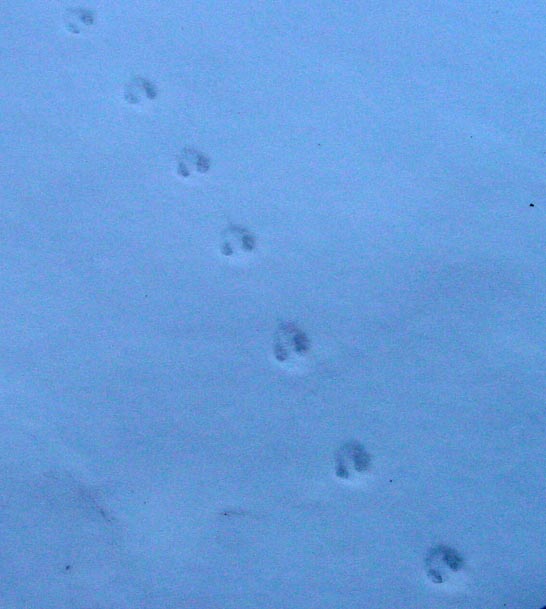 Fact is, unless I have wee marsupial-type critters in my yard, I would guess that many of the tracks I saw today were made by birds. Like those above. I didn't see anything that looks like mouse or chipmunk trails and those are the only small mammals hereabouts. A little disappointing. (And yes, I did consult with The Google to back up my theorizing.)
 This is another set of tracks, even smaller, looking like a small bird was hopping along.
 On the other hand, there's no question about who made these much larger hoof prints: that javelina family of four which seems to have moved into the immediate neighborhood.
 But then I didn't need hoof prints to tell me javelina have been around. For your information, the Internet is loaded with pictures and references on animal scat. Even better, you can buy your own replicas for the coffee table at under $10 a pop here.
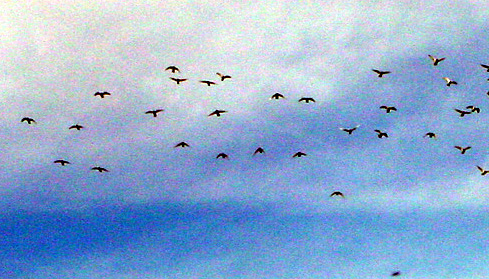 As I've wandered the city looking this way and peering that way, I've come to realize just how beautiful the local flocks of pigeons are. In flight, that is. They swoop, they circle, they make sudden U-turns. In the process, the group aspect changes from black to white and to black again. Just as though MC Escher had invented the pattern.

 As these pictures show, the birds aren't exactly in unison -- some wings are on an upbeat, others on a downbeat. But it's amazing how such a leaderless flock acts more or less as one. It's long puzzled scientists, too! The latest study I've seen reference to features arcane mathematical models.
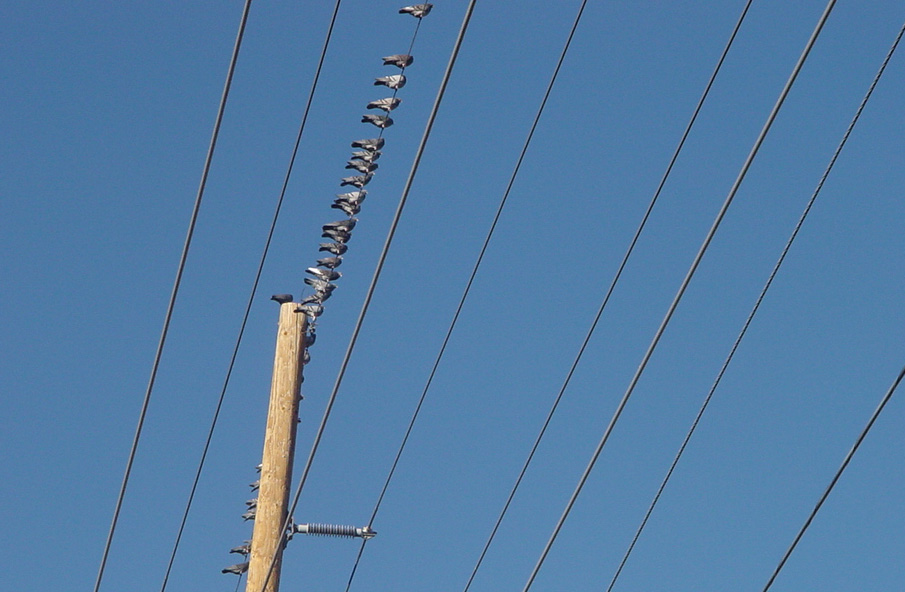 Look at the choices available above -- why on earth would all the birds choose to land on the same wire?
 And all face in the same direction while they're about it?
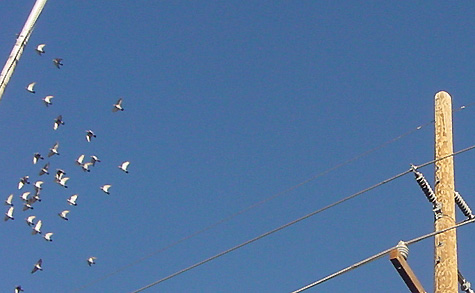 But they didn't all take off at the same time.
 Now here we have not a flock, but five very social birds -- acorn woodpeckers who were making a fine racket one day as I was out walking. Where's #5? Look closely and you'll see a couple of tail feathers sticking out from behind the utility pole on the left. There's also a bare pine top I can see from my kitchen window where up to six woodpeckers regularly congregate; they are a communally nesting tribe. By the way, you don't have to look very hard to see acorn-sized holes -- and home-sized holes in that pole above.
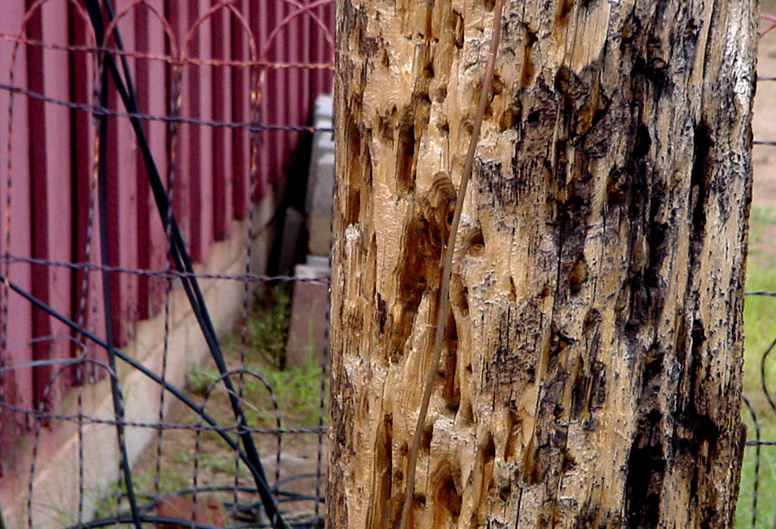 After years of woodpeckers, insects and weather, this is the fate of wooden utility poles. No doubt the reason we're likely to see a lot more birdless iron up in the sky (below).
 Sometimes I wist, but bird photography is not my thing! My little digital snap shooter can stop a flock quite nicely (maybe one out of ten shots.) But to really take pictures of individual birds, I'd need a lot more camera and even more lens -- that plus the requisite tripod. Couldn't do any walking weighed down under that gear! So, for great Arizona bird pictures, start up near the top of this page under the heading Naz Nature on the right hand side. Firefly Forest, Nature Songs and Wings of Nature all post some terrific Arizona bird pictures. That's why they're listed up there!


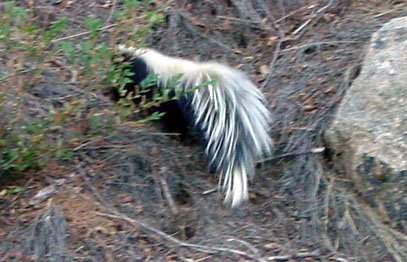
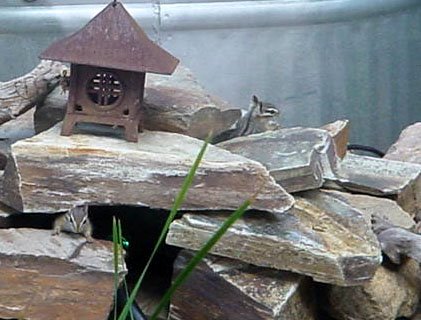
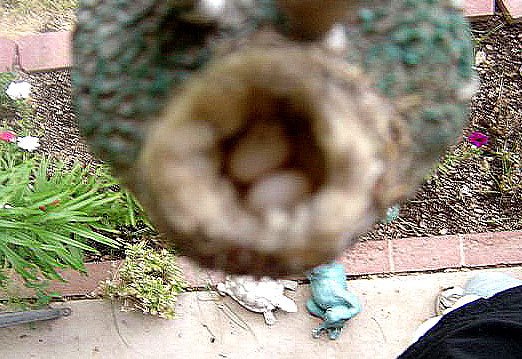
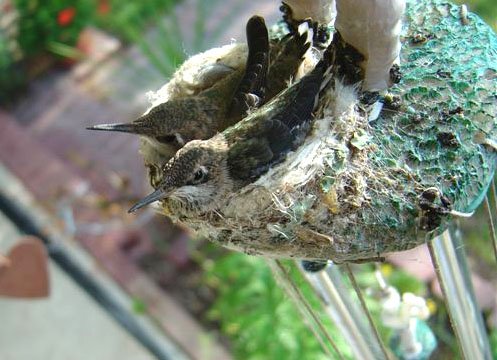
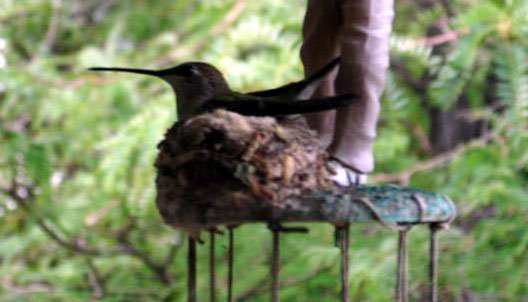 Here is the mom, taken a little bit earlier -- note how long her beak is, compared to the youngsters. Looks like they have some growing to finish!
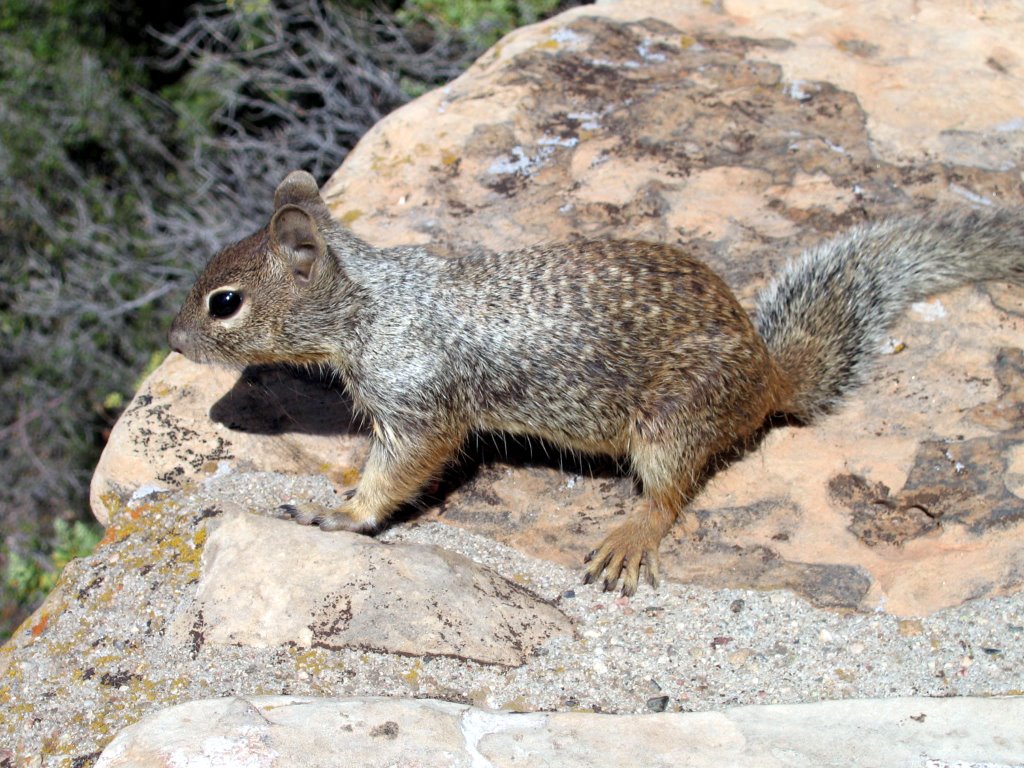
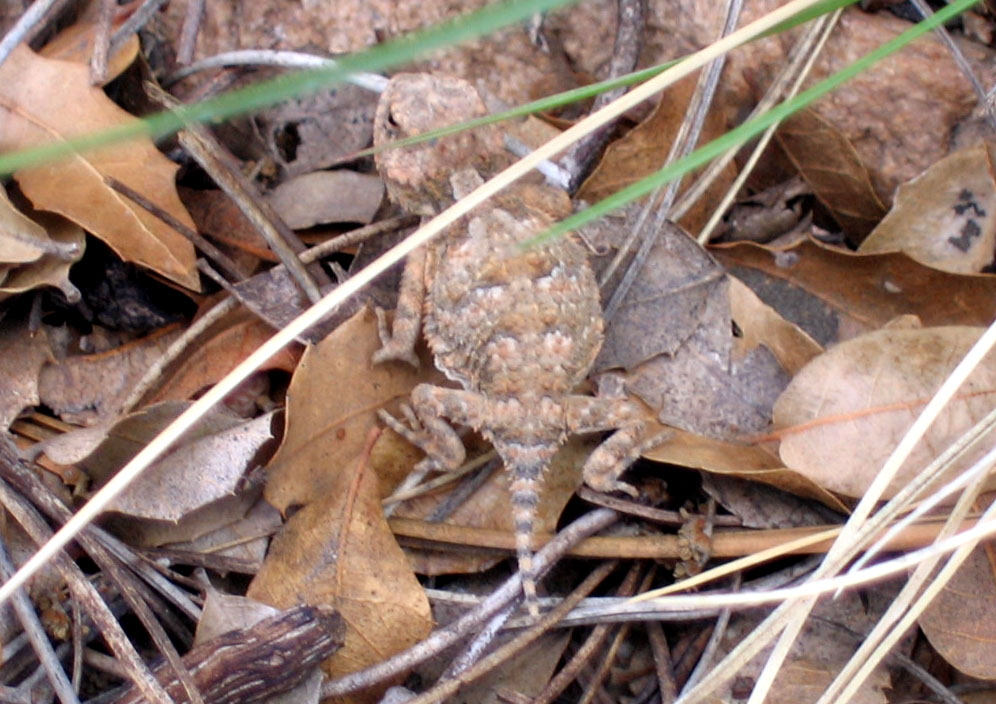 It's been years since we had horned toads in the neighborhood -- back in the 80s, I saw as many little hornies as I see other brands of baby lizards nowadays. The aforementioned nephew caught this one up on Thumb Butte and the fat squirrel (below) at the Grand Canyon. (We've got too many cats patrolling our neighborhood for squirrels to feel comfortable.)
 Note: For previous critter reports, go here, here, and here.

 Posts
All Comments
Posts
All Comments


